Insights
Every trade word, in plain English .
30 terms you will hear on a media plan, defined without the jargon that usually comes with them.
Formats
- Hoarding
- The Indian term for a large-format printed billboard. Mounted on a wall, a rooftop or its own frame.
- Unipole
- A board carried on a single steel pole, well above traffic. Standard on highways because nothing at ground level can block it.
- Gantry
- A structure that spans the carriageway, carrying a board over the traffic beneath it.
- Trivision
- A board whose face is built from rotating triangular slats, so one structure shows three creatives in turn.
- DOOH
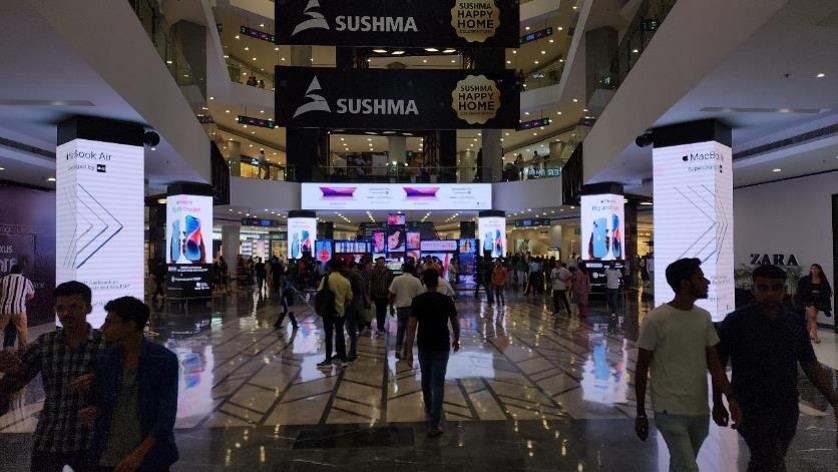
- Digital Out Of Home. Advertising on screens rather than printed media, sold by time slot instead of by month.
- Pole kiosk
- Small double-sided panels mounted on street-light poles, usually bought in runs along a road.
- Transit media
- Advertising on vehicles — buses, autos, cabs — that travels through the city rather than waiting for it.
- Cut-out
- A three-dimensional element built out past the edge of the board so the creative breaks the rectangle.
Lighting
- Front-lit
- Floodlights mounted in front of the board, shining onto the face. The most common roadside lighting.
- Back-lit
- Light sits behind a translucent flex and glows through it. Even, premium, and more expensive to build.
- Halogen
- Older tungsten-halogen lamp housings. Warmer light, much higher power draw, being replaced with LED across the industry.
- Non-lit
- No lighting. Priced lower and perfectly sound on routes that are busiest in daylight.
Materials
- Flex
- The coated PVC fabric a board is printed on. Sold by GSM — higher GSM holds tension longer and tears less.
- GSM
- Grams per square metre. The weight of the flex. 380–440 for front-lit, 450–510 for back-lit.
- Star flex
- A lighter, cheaper flex used for short cycles and events.
- Vinyl
- Self-adhesive film for signage, glass and vehicles. Measured in microns.
- ACP
- Aluminium Composite Panel. The rigid sheet most modern shop-front fascias are built from.
Measurement
- Impressions
- The number of people estimated to pass a site in a day. An estimate from traffic and footfall counts, not a headcount.
- Dwell time
- How long an average viewer can see the board. A signal approach has high dwell time; a fast open road has very little.
- Reach
- The share of a target audience that sees the campaign at least once.
- Frequency
- How many times the average person sees it. Outdoor sells frequency more cheaply than almost any other medium.
- Loop
- On a digital screen, the full cycle of advertisers before yours plays again. An 80-second loop means roughly 45 plays an hour.
- Dayparting
- Scheduling different creative by time of day. Only possible on digital media.
Buying
- Media owner
- The company that owns the structure and holds the site licence. We are one. Most of the market are not.
- Aggregator
- A reseller who books other people's inventory. Convenient, but cannot control condition, availability or the final price.
- Cycle
- The standard booking period — in India, one calendar month.
- Media plan
- The costed list of sites for a campaign: which boards, what size, what dates, what it comes to.
- Rate card
- The published monthly rate for each site before any negotiation or package discount.
- Proof of display
- A geotagged photograph of your creative actually up on the board. Ask for it. Most of the market cannot produce one.
- Site code
- The unique reference for one physical board. Always quote it — two sites on the same road can be very different buys.